
Playoff Experience
If you can't let it go, do it for course credit


I was tired of hearing about playoff experience when I was about twelve. It’s a trope that exists in every sport with a postseason but it exerts this terrifying explanatory capacity in a tournament as prone to randomness as the Stanley Cup Playoffs. The playoffs, players, coaches and media members will attest to, are a totally different animal. A young team, even a talented one, will struggle to perform with the intensity dialed all the way to eleven.
When my Toronto Maple Leafs were young and cute, they arrived in the postseason ahead of schedule for an ill-fated bout with the President’s Trophy winning 2016-17 Washington Capitals. The vibes were immaculate then. Comment sections exuded a grandfatherly patience instead of the present sunglassed uncley rage. The Leafs accrued grizzled grit points for going 2-1 up off a tricky overtime goal that grizzled veteran Brian Boyle created on an unmistakably veteran play.
There was this certainty that wonderful things were waiting in the future, just a little out of sight. There was this stoic patience that began to border on arrogance; this certainty that this lovable bunch of wunderkinds would age gracefully into Boylian fundamentals.
Of course, my Leafs didn’t win that series. The Leafs never did go all in while their young core was overperforming on entry-level contracts. As their postseason game totals have cumulatively skyrocketed this dire decade, the discourse of experience has given way to one of losers and chokers.
Fast forward seven years, my graduating sport media class was given the opportunity to write a literature review on literally anything we wanted. Some people studied the noblest causes possible in our domain - gender dynamics in sports coverage, concussion statistics, the effectiveness of the Rooney Rule - I opted, instead, to interrogate my long-standing pet peeve.
On Floundering Literature Reviews:
To my delight, a great deal of scholarly literature has been ceded to the unsubtle interrogation of long-standing pet peeves. But researchers are never allowed coming out and saying it. This will help sports gamblers, sports researchers insist. And general managers who went to fancy business schools and kept renewing their JSTOR accounts.
That being said, there isn’t any overwhelming quantity of literature devoted to postseason experience as there is with, say, home field advantage. That creates the awkward situation where researchers are obligated to lend so and so many pages to literature reviews even when the literature itself is pretty scant. Early research in postseason experience flounders to find a theoretical framework. Authors, then, scrounge up tangentially related articles about experience in the common workplace.
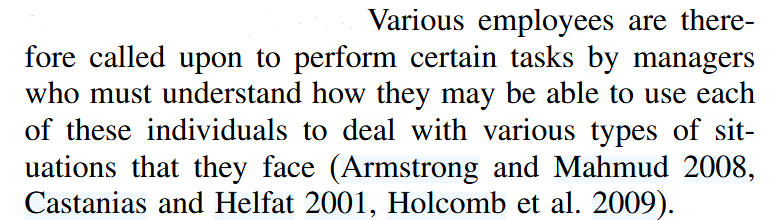
(Shamsie & Manor, 2013)
That, you might think, doesn’t sound totally analogous. Postseason experience isn’t about older players outperforming younger ones. It’s about players accustomed to a higher level of intensity outperforming those who aren’t. It’s experience in high-pressure environments that seems sought after - not experience in and of itself.
Dr. N. David Pifer is one of those rare researchers who centered a whole study around playoff experience. His 2019 article in the Journal of Sports Analytics examined March Madness brackets over a 10-year period. I had the privilege of interviewing him for this article, though I probably would’ve found an excuse to talk to him anyway.
To my chagrin, Pifer’s study identified a small but statistically significant trend in the later rounds of the tournament. Class rank, that is, the athlete’s year of study, was not found to be predictive of wins. From Sweet 16 onward, though, minutes of experience among a team’s starters was one of the few significant variables he could identify. A 27-minute difference in March Madness experience between NCAA starters amounted to a one-point difference per game past the Sweet 16. 26 minutes, incidentally, was the mean difference in March Madness experience between opponents. This sounds infinitesimally small until you consider that games at this stage of the tournament are decided, on average, by just 10 points.
Unlike previous research, Pifer actually does consider theories pertaining to pressure and stress. He floats Hans Eysenck’s inoculation hypothesis as a potential explanation for the overperformance of tournament experienced student-athletes. That’s another can of worms, but in short, exposure to stressful stimuli might strengthen our resistance to similar stimuli in the future.
“Once you're exposed to something, inoculated to something, in theory, that should make you immune to the stresses that follow,” Dr. Pifer explained.
I ran into a pretty similar theory writing my undergrad paper. I had expected to find some convenient tidbit tucked away in some study about workplace performance during crunch time. Instead, one Roy Baumeister kept me ensnared in sport.
Baumeister’s explicit monitoring theory, from a 1984 article in the Journal of Personality and Social Psychology has to do with ‘choking’ under pressure. Have you ever had to do something you’d done 100 times before in front of a lot of unblinking eyes - something you were certain you were very good at? You might find yourself unable to just up and do it. You might begin to fixate on every individual step of a skilled task. Your heightened attention to detail, EMT suggests, paradoxically hinders your execution. But like with inoculation, Baumeister proposes that a person consistently exposed to high stressors might eventually be able to cope with them.
Much confirmation for EMT, indeed, comes from studies of sport. These are actually a lot of fun to read since they usually involve researchers hoodwinking their subjects! McEwan et al.’s 2012 article published in the journal Advances in Sport Education might be my favourite.
McEwan’s team took a bunch of university students to a golf course and split them into three groups. They told one group they were documenting the mini-putting talents of college students, the next group their strokes were being recorded and tallied against their peers and the high-pressure group that they were competing for a small cash prize.
They actually all performed roughly the same in Dr. Desmond McEwan’s putting challenge. Where they diverged was in the following mock ‘tiebreaker’, where participants were told there had been a tie in strokes between two imaginary competing teams. Participants from the high-pressure group were almost twice as likely to sink their final putts!
There you go, then. It seems like we have a pretty compelling story. People need to be inoculated to stressful scenarios. A 2019 recreation of Pifer’s study in the women’s tournament bracket went on to identify an even stronger correlation.
Pro Sports:
That’s well and good until you get to parallel studies of professional sport, which have almost universally identified no such correlation. There’s the basketball one, the football one, the soccer one, a smattering of baseball ones and I’m gonna write the hockey one if no one beats me to it.
So what gives? Why would playoff experience matter in college sports but not pro? That gradually became the central question of my undergrad paper! My best guess gets back to Baumeister. Stress is the answer, but we weren’t thinking quite broadly enough.
Amateur and junior athletes, believe it or not, deal with their fair share of stressors en route to professional careers. As Dr. Joshua Pitts describes in his article linked above: “Many of these players may have participated in high school state championship games, college bowl games, and NFL regular season games where their teams had a lot at stake.”
The logic of postseason experience gets murkier when you ask yourself why a basketball player dragged through the whimsey of March Madness would suddenly fold in a best-of-seven playoff series. Athletes can become inoculated to stressful scenarios, but maybe, just maybe, that inoculation carries over to professional play.
That’s my story right now, but it’s not perfect. Pitts’ study showed, for example, that quarterbacks playing their first seasons for new teams were 12-15% less likely to beat their opponents. The basketball paper linked above showed that playoff experienced coaches also fared a little better. And where EMT seems to explain the execution of isolated skilled tasks, like putting and shooting foul throws, it’s a lot less clear whether it would carry over to entire games and series.
"It's easy to look at [experience] in those contexts," Pifer said. "But when you get into the whole measure of basketball game performance, there's a lot of other things that go into winning and losing besides, you know, a free throw.”
The most persistent barrier to good data, though, might be our inability to control for team quality. Good teams will, of course, generally advance more often every postseason. Good teams, by virtue of being good, will often end up with a lot of playoff experience.
“There’s no perfect control for talent differences,” Dr. Pitts said. “You just do the best you can do.”
And so, in cowardly fashion, I’m going to be a little patient. It can be shockingly hard to vanquish your least favorite cliches - it can be shockingly hard to handwave the most trivial pet peeves. I wanted a neat little story to tell myself about how the Leafs could’ve turned out different if they were only a little different.
And maybe I’ll get a definitive one! I’ll just have to wait a little longer.